skum
Aarhus, Denmark
2018
Aarhus, Denmark
2018
References
Goffman, E. (1990 [1959]). The Presentation of Self in Everyday Life. England: Penguin Books.
Hammersley, M. og P. Atkinson. 2007. ”The process of analysis” in: Hammersley, M. og P. Atkinson, Ethnography: Principles in practice. London: Routledge. 158-191
Høgel, J. K. 2013. Montage as analysis in ethnographic and documentary filmmaking: From hunting for plots towards weaving baskets of data. 213-225 in Transcultural Montage (ed. C. Suhr and R. Willerslev). London: Berghahn Books.
MacDougall, D. 1997. The Visual in Anthropology. 276-295 in Banks, M. and Morphy, H. (eds.) Rethinking visual anthropology. New Haven: Yale University Press.
Willerslev, R. and Suhr, C. 2013. Introduction: Montage as an Amplifier of Invisibility. 20-39 in Transcultural Montage (ed. C. Suhr and R. Willerslev). London: Berghahn Books.
Collaborators:
︎︎︎ Institute for (X)
Film crew:
︎︎︎ Katrine Krøjgaard
︎︎︎ Kirsten Dreizler Jensen
︎︎︎ Saga Kapna
Goffman, E. (1990 [1959]). The Presentation of Self in Everyday Life. England: Penguin Books.
Hammersley, M. og P. Atkinson. 2007. ”The process of analysis” in: Hammersley, M. og P. Atkinson, Ethnography: Principles in practice. London: Routledge. 158-191
Høgel, J. K. 2013. Montage as analysis in ethnographic and documentary filmmaking: From hunting for plots towards weaving baskets of data. 213-225 in Transcultural Montage (ed. C. Suhr and R. Willerslev). London: Berghahn Books.
MacDougall, D. 1997. The Visual in Anthropology. 276-295 in Banks, M. and Morphy, H. (eds.) Rethinking visual anthropology. New Haven: Yale University Press.
Willerslev, R. and Suhr, C. 2013. Introduction: Montage as an Amplifier of Invisibility. 20-39 in Transcultural Montage (ed. C. Suhr and R. Willerslev). London: Berghahn Books.
Collaborators:
︎︎︎ Institute for (X)
Film crew:
︎︎︎ Katrine Krøjgaard
︎︎︎ Kirsten Dreizler Jensen
︎︎︎ Saga Kapna
The film
In this film essay I explore two key concepts within the field of Visual Anthropology: Performance and Montage. I will examine the notion of Performance as described by Erving Goffman (1990:28-82). Then I will focus on the concept of Montageas it is described by Christian Suhr and Rane Willerslev (2013) on the one hand and its applicational value as discussed by Jakob Høgel (2013) on the other. The reason that I have chosen to explore Performance and Montage, is because these two concepts proved to be essential guidelines in relation to the making and editing of the student project film ‘skum’. Which has been handed in along with this paper. I recommend that the reader watch the film after reading this paper, in order to see how the ideas discussed have been applied in the process and the final product.
skum: the film
skum is the product of hard work and two intensive weeks attending the Summer University Course: “Visual Anthropology Today: Infrastructures for seeing, thinking and knowing.” at Aarhus University. We, the students, were given several tasks, that served as an introduction to the field of visual anthropology. Ultimately these tasks led to the creation of a short film, titled ‘skum’, which I will return to in my conclusion.
Framing Visual Anthropology
To better understand some of the capabilities of visual representations in anthropology, I will draw on David MacDougall’s (1997) description of visual ethnography. According to him, visual ethnography can serve as a metaphor for the real i.e. Visual material can act as a medium in which the observable real can be transported over vast distances and into the hands, eyes and minds of new spectators. Thereby acting as a gateway or representation for the experiences the ethnographer has brought back from the field (ibid.:277). Albeit he admits that there is a lurking danger in any uncaptioned photograph, the danger of interpretation, in his own words: “Unlike written descriptions, which always provided some sort of context, a photograph could be supplied with any sort of meaning by the viewer - from competing scientific discourses, or unwelcome popular ones such as racism.” (MacDougall 1997:289-90). Another feature of visual ethnography - and equally as important - is the possibility that it can serve as a medium for indigenous people to represent themselves through their own visual productions and give them a voice of their own, in what he terms Indigenous media production, which holds the potential for new kinds of dialogue to emerge between ethnographer and informant (ibid.:283). The importance lies in the fact that the power of exhibition no longer resides solely in the hands of the ethnographer or anthropologist. As visual ethnography develops, so does the responsibilities of the ethnographer, namely the responsibility of contextualising or captioning the visual material, in a way that does not allow for ignorant interpretations, he writes: “There is a moral imperative against allowing viewers to jump to the wrong conclusions.” (ibid.:290). The difference between written and visual anthropology as described by MacDougall, is that “Visual anthropology can never be either a copy of written anthropology or a substitute for it. For that very reason it must develop alternative objectives and methodologies that will benefit anthropology as a whole.” (ibid.:292-93).
With an Audience
Moving on from here and towards the notion of performanceand by extension the performer. Goffman describes performances as comprised of different elements, namely frontstage and backstageevocations or behaviours (Goffman 1990:23-33, 79). There are ways in which we perform when knowing that we are in the audience’s visible field, and then there are things or behaviours that we hide away ‘behind-the-scenes’, out of sight from the audience’s perspective. Goffman explains it as follows: “Throughout our society there tends to be one informal or backstage language of behaviour, and another language of behaviour for occasions when a performance is being presented.” (Goffman 1990:129). He argues that the frontstage behaviour is an expression of a desire inherent within the performer to move ‘upward’ in the world, Goffman refers to this motion upwards as social mobility (ibid.:45). Social mobility in this sense can best be understood as any performer’s desire to be sustained or elevated from his or her social statue to a higher one, even if only for the duration of the present performance i.e. any performance is conducted with the purpose of placing the performer in an upward motion in respect to social statue or position, even if only momentarily (ibid.:45-49). Following this idea, what Goffman is saying is; any performer will for the most part, present him- or herself in a manner that gives the best impression or sheds the most desirable light on that performer. There is a relational connection or dependency between frontstage and backstage behaviour. One that constitutes any person’s ability to navigate in social interactions, he explains how frontstage and backstage behaviours act as moderators for each other, by stating: “In general […] backstage conduct is one which allows minor acts which might easily be taken as symbolic of intimacy and disrespect for others present and for the region, while front region conduct is one which disallows such potentially offensive behaviour.” (ibid.:129). Front region conduct allow the audience to see only what the performer allows or invites them to see i.e. front region conduct obscures the fact that there are things and behaviours undisclosed and hidden away.
Looking behind the curtain and experiencing the Invisible
Anthropologists Christian Suhr and Rane Willerslev asserts that: “Montage, in its broadest sense, simply implies the joining together of different elements in a variety of combinations, repetitions, and overlaps.” (2013:1). They argue that when editing and combining visual material, the end result is something more than the sum of the original pieces combined, something new becomes evident, something that was not initially visible or maybe even entirely invisible. They state that montage in visual ethnography can contribute to social theory through: “its capacity to generate analytics and anti-analytics while maintaining a space for the invisible.” (Willerslev and Suhr 2013:1). Their assertion is that: “the destabilization and rupture of our common-sense perception is the very condition for transcending cultural boundaries.” (ibid.:2). Montage is thus, the method or instrument through which the condition for transcending cultural boundaries can emerge. Moreover they argue that we should not try to force the invisible into the field of the visible, simply because we would risk deceiving ourselves and thereby be denoted to what they call naïve realism, which is: “the commonsensical attitude which holds that our senses give us a direct and transparent window to reality ‘as it is,’ and that objective truth entails only accurate reportage of its observable detail.” (ibid.:2). This deception can be avoided by acknowledging the existence and the enigma of the invisible, that otherness which can not be framed in its entirety in visual material; a feeling, a persons private thoughts and beliefs, emotional state etc. (ibid.:4-5)
Fluidity and Invisibility
This notion of something hidden or invisible, something we cannot bring completely into the field of the visible even throughmontage, can also be understood in relation to Goffman’s theory of performanceas mentioned earlier in this paper. Where the two ideas differ, is in respect to their audience. There is a sense of fluidity intrinsic to Goffman’s idea of audience. The audience changes along with the performers position, being either frontstage or backstage i.e. there are two different audiences, one frontstage and one backstage. The exchanges that happen and the attitudes that are taken on between different performers backstage are entirely or partly invisible to the audience situated frontstage, but at the same time they are very visible among the performer’s backstage. The same goes for visual ethnography but contrary to the above, visual material is always presented frontstage. What Suhr and Willerslev (2013) are arguing, is that by presenting the material in the form of a montage, a window of opportunity arises, namely a chance for frontstage audiences to experience or discover that there are elements in the material that are unobtainable or hidden from the viewer, a gab between what is seen and what is experienced. In line with this thought, montage is a method that can stress the point ‘what you see is not the whole picture.’ So instead of a transparent and clean window, the surplus that is created when combining different audiovisual materials through montage, testify to the existence of something out-of-sight or entirely invisible to the viewer (Willerslev and Suhr 2013:4-6). These enigmas are part of the narrative framework. They help to ‘push’ or guide the audience down a fixed path, and by manipulating the visual material through montage, the editor can distinguish and discard those elements that does not help to manoeuvre the audience’s experience in accordance with the narrative framework.
Moving Into the editing suite
The process of editing starts with the way the camera is being operated and in the choices of framing, content and composition. In filmmaking, montage is a method the editor can apply in order to free the material from the confines of chronological and linear storytelling (Høgel 2013:214). Montage can be utilised as an analytical tool, the chopping up, logging and reassembling of visual material is analogous to anthropological analysis (ibid.:215-16). According to sociologist and anthropologist - Hammersley and Atkinson (2007) - the methods, procedures and techniques applied by an anthropologist, when going through his or her material e.g. field notes, interviews, photographs etc. and the skilful act of dismantling the data and reassembling it through coding and anthropological analysis is not bound up by ready-made procedures or recipes that will guarantee success. This is to be understood in the sense that the data will not present the whole natural truth. The way ethnographers or filmmakers should conceive raw data then, is like Hammersley and Atkinson writes: “Data are materials to think with” (2007:159). Through the process of ‘thinking with,’ data becomes contextualised either in writing or in a audiovisual representation. Material - be it written or audiovisual - is a medium through which information is being processed and ultimately interpreted on. It is the filmmaker’s, like the anthropologist’s, responsibility to contextualise the audiovisual material in a way that prevents misguided interpretations (Høgel 2013:223-24). Anthropology can provide filmmaking with the analytical perspectives and methodology needed to strengthen the relationship between cultural analysis and narrative framework (ibid.:216).
skum: in conclusion
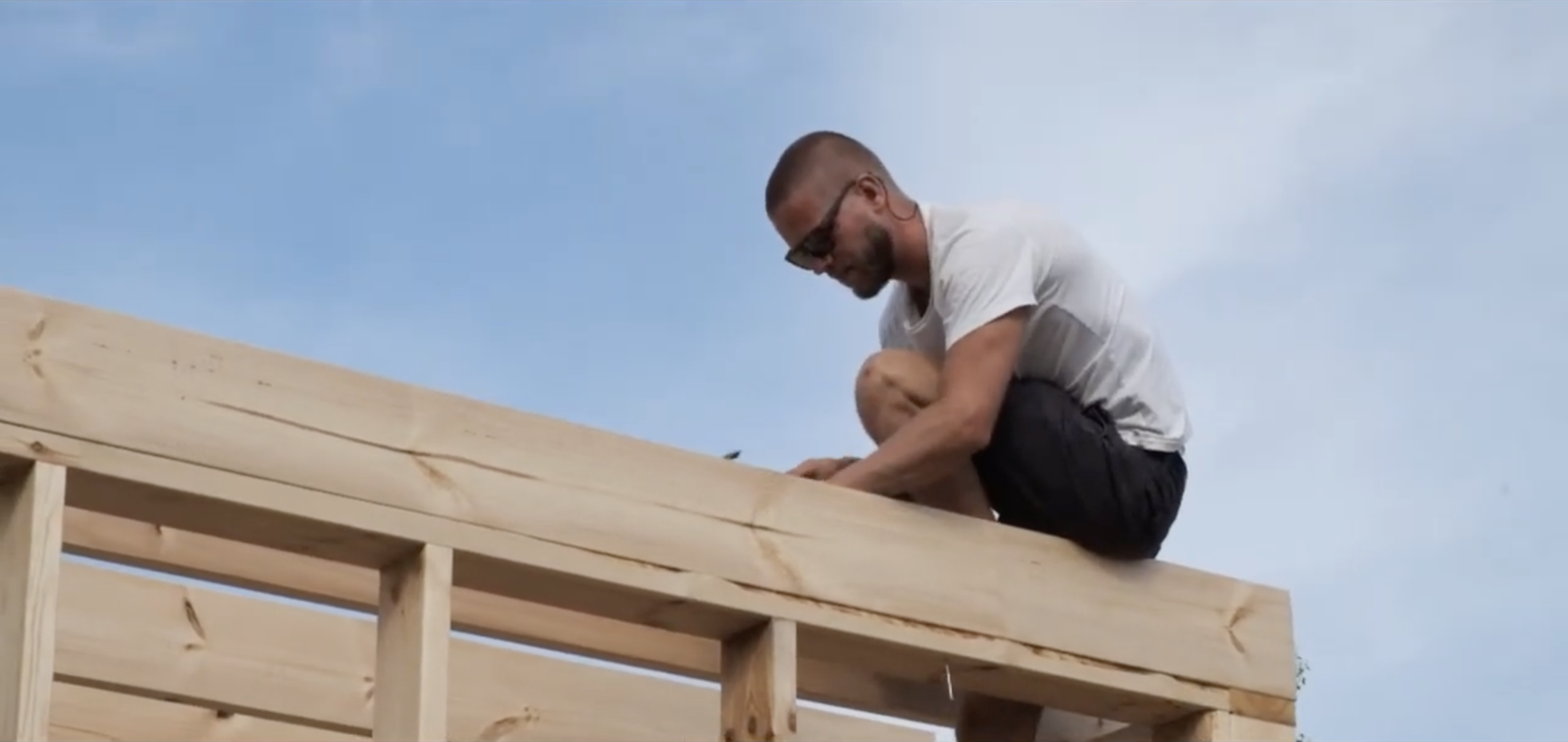
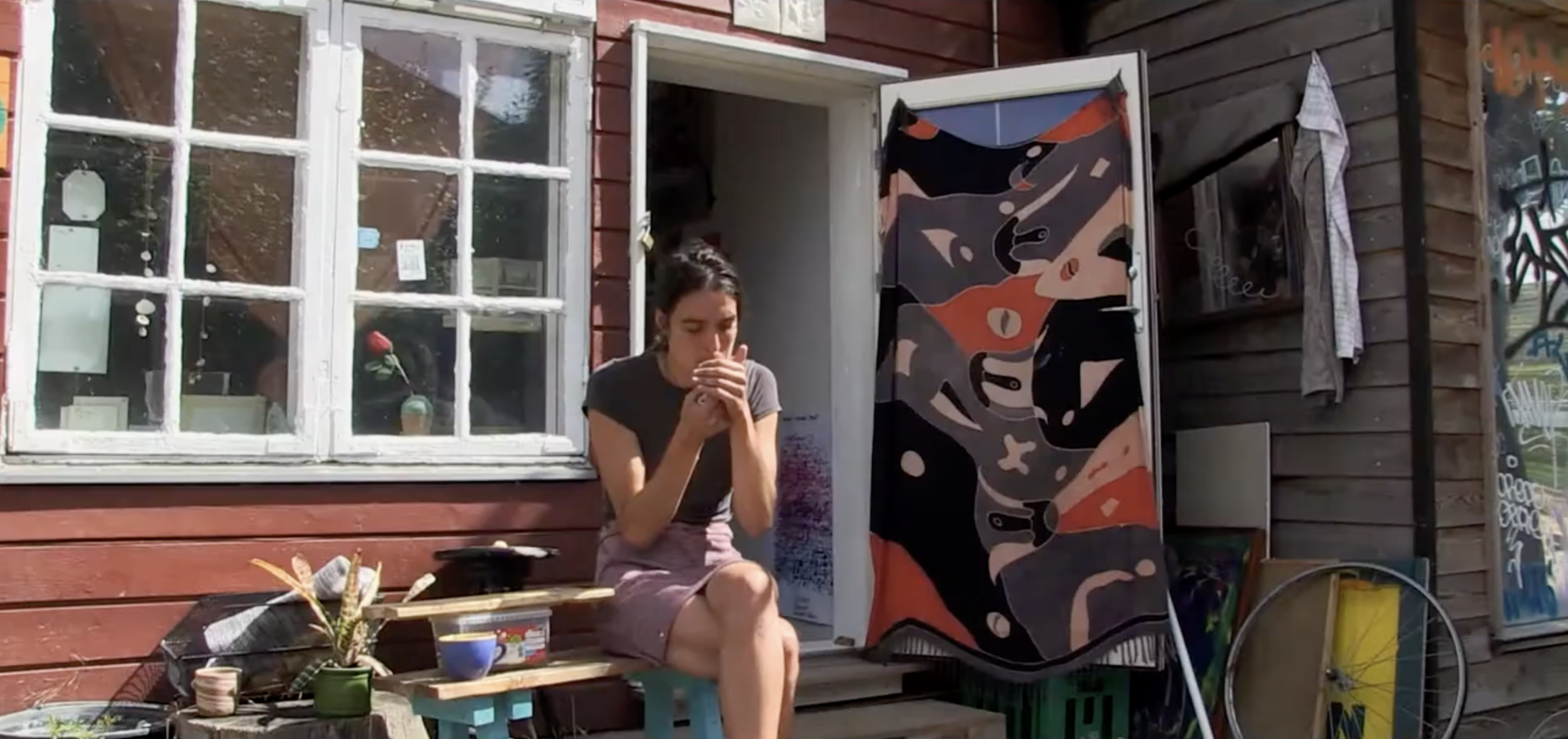
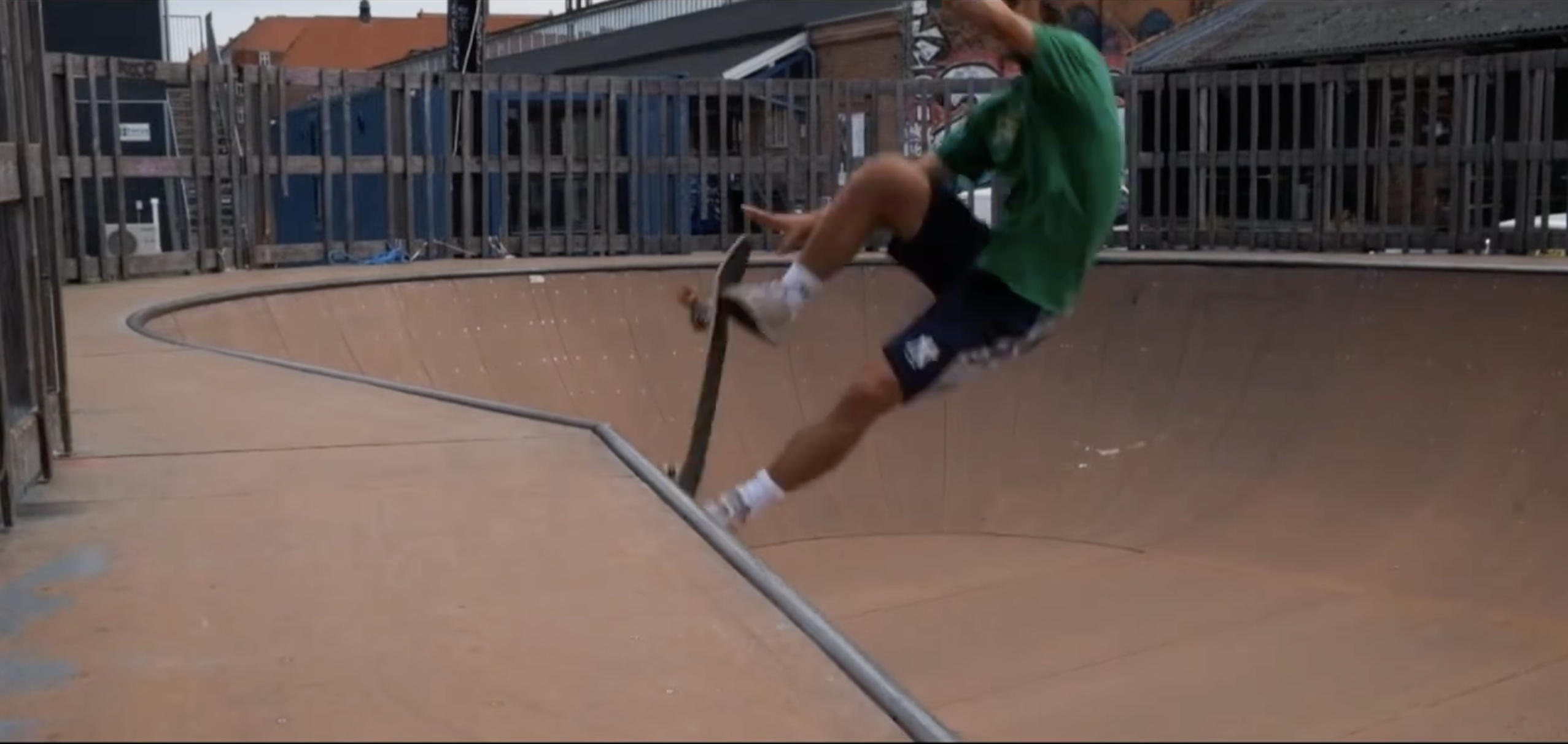
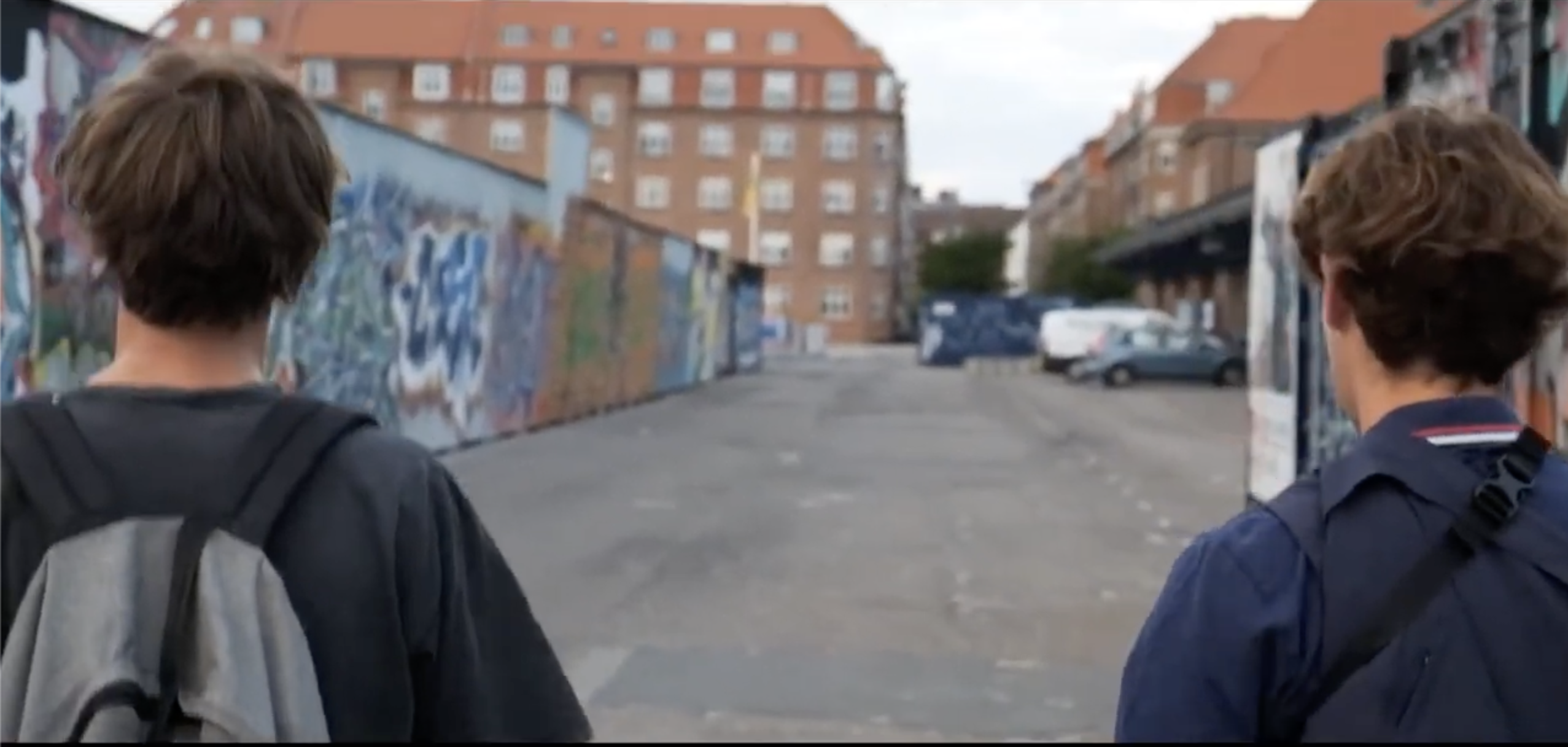
The student project film skum is in many ways an attempt to encode the above-mentioned notions into a visual representation of the area commonly referred to as Godsbanen, in Aarhus. The reason I have chosen to highlight performanceand montage in this paper is because they became our guidelines in pursuing the project as anthropologically justified as possible. I am not saying that the use of these ideas is necessarily anthropologically sound, but they served as our ‘watchdogs' while we were conducting our fieldwork and later as we worked with our audiovisual material in the editing suite. Knowing that people perform to present themselves in the best possible way and that we were their frontstage audience, we quickly became aware that we could not portray any one person without losing important insights, about other parts of the area and its occupants. Following this realisation, we briefly ventured down a path of wanting to portray the area as a whole. This also proved to be a troublesome path for us to explore. Mainly because of the fractious nature concerning the organisation of businesses and other occupants in the area. Finally, we decided to stop forcing a narrative structure or framework onto our field and its occupants and instead follow the material as it presented itself in front of the camera. By gathering a database of material, and letting that material speak for itself, we found that a pattern emerged from our database, much in the way described by Jakob Høgel: “It is about seeing qualities that may not stand out in a single clip but can become visible when put in a certain sequence.” (Høgel 2013:222). We discovered that a strict hierarchy were omnipresent but not entirely vocalised, at least not on the surface. This caught our attention, and we started to pursue this idea by exposing ourselves, camera in hand, to our field. Over the course of several days, we slowly gained the trust of a growing number of informants. Finally, in an almost cartoonist fashion, I was approached by a man who asked me what my deal was and why I had been roaming around for the last couple of days with a camera. I told him that I was there to make a film about the area, as part of my summer course in Visual Anthropology. Following this, he introduced himself as the unofficial king of Godsbanen. We decided to do an interview with him. The interview and filming were to be done by me alone, in an attempt to downplay the innuendo of our project and its potential, hoping that we would get a less inflated and a more sincere or honest performance from him. During the interview he explained in bits and pieces the philosophy that is the foundation of his project, which is called ‘Institute for X,’ commonly referred to as Godsbanen. This philosophy or discourse became our narrative framework. So instead of giving one individual a voice, we decided to give voice to the discourse. This was done by juxtaposing the description of the discourse given by him in words, and the audiovisual material gathered from the area, in a montage. In conclusion the utilisation of Montage and Performance as described above, provided us with the necessary tools and know-how to incapsulate and work with the audiovisual material we collected during our fieldwork. Ultimately the use of these ideas made it possible for us to present our material, in a form that is as honest towards both our participants and us - the audience - as possible.
In this film essay I explore two key concepts within the field of Visual Anthropology: Performance and Montage. I will examine the notion of Performance as described by Erving Goffman (1990:28-82). Then I will focus on the concept of Montageas it is described by Christian Suhr and Rane Willerslev (2013) on the one hand and its applicational value as discussed by Jakob Høgel (2013) on the other. The reason that I have chosen to explore Performance and Montage, is because these two concepts proved to be essential guidelines in relation to the making and editing of the student project film ‘skum’. Which has been handed in along with this paper. I recommend that the reader watch the film after reading this paper, in order to see how the ideas discussed have been applied in the process and the final product.
skum: the film
skum is the product of hard work and two intensive weeks attending the Summer University Course: “Visual Anthropology Today: Infrastructures for seeing, thinking and knowing.” at Aarhus University. We, the students, were given several tasks, that served as an introduction to the field of visual anthropology. Ultimately these tasks led to the creation of a short film, titled ‘skum’, which I will return to in my conclusion.
Framing Visual Anthropology
To better understand some of the capabilities of visual representations in anthropology, I will draw on David MacDougall’s (1997) description of visual ethnography. According to him, visual ethnography can serve as a metaphor for the real i.e. Visual material can act as a medium in which the observable real can be transported over vast distances and into the hands, eyes and minds of new spectators. Thereby acting as a gateway or representation for the experiences the ethnographer has brought back from the field (ibid.:277). Albeit he admits that there is a lurking danger in any uncaptioned photograph, the danger of interpretation, in his own words: “Unlike written descriptions, which always provided some sort of context, a photograph could be supplied with any sort of meaning by the viewer - from competing scientific discourses, or unwelcome popular ones such as racism.” (MacDougall 1997:289-90). Another feature of visual ethnography - and equally as important - is the possibility that it can serve as a medium for indigenous people to represent themselves through their own visual productions and give them a voice of their own, in what he terms Indigenous media production, which holds the potential for new kinds of dialogue to emerge between ethnographer and informant (ibid.:283). The importance lies in the fact that the power of exhibition no longer resides solely in the hands of the ethnographer or anthropologist. As visual ethnography develops, so does the responsibilities of the ethnographer, namely the responsibility of contextualising or captioning the visual material, in a way that does not allow for ignorant interpretations, he writes: “There is a moral imperative against allowing viewers to jump to the wrong conclusions.” (ibid.:290). The difference between written and visual anthropology as described by MacDougall, is that “Visual anthropology can never be either a copy of written anthropology or a substitute for it. For that very reason it must develop alternative objectives and methodologies that will benefit anthropology as a whole.” (ibid.:292-93).
With an Audience
Moving on from here and towards the notion of performanceand by extension the performer. Goffman describes performances as comprised of different elements, namely frontstage and backstageevocations or behaviours (Goffman 1990:23-33, 79). There are ways in which we perform when knowing that we are in the audience’s visible field, and then there are things or behaviours that we hide away ‘behind-the-scenes’, out of sight from the audience’s perspective. Goffman explains it as follows: “Throughout our society there tends to be one informal or backstage language of behaviour, and another language of behaviour for occasions when a performance is being presented.” (Goffman 1990:129). He argues that the frontstage behaviour is an expression of a desire inherent within the performer to move ‘upward’ in the world, Goffman refers to this motion upwards as social mobility (ibid.:45). Social mobility in this sense can best be understood as any performer’s desire to be sustained or elevated from his or her social statue to a higher one, even if only for the duration of the present performance i.e. any performance is conducted with the purpose of placing the performer in an upward motion in respect to social statue or position, even if only momentarily (ibid.:45-49). Following this idea, what Goffman is saying is; any performer will for the most part, present him- or herself in a manner that gives the best impression or sheds the most desirable light on that performer. There is a relational connection or dependency between frontstage and backstage behaviour. One that constitutes any person’s ability to navigate in social interactions, he explains how frontstage and backstage behaviours act as moderators for each other, by stating: “In general […] backstage conduct is one which allows minor acts which might easily be taken as symbolic of intimacy and disrespect for others present and for the region, while front region conduct is one which disallows such potentially offensive behaviour.” (ibid.:129). Front region conduct allow the audience to see only what the performer allows or invites them to see i.e. front region conduct obscures the fact that there are things and behaviours undisclosed and hidden away.
Looking behind the curtain and experiencing the Invisible
Anthropologists Christian Suhr and Rane Willerslev asserts that: “Montage, in its broadest sense, simply implies the joining together of different elements in a variety of combinations, repetitions, and overlaps.” (2013:1). They argue that when editing and combining visual material, the end result is something more than the sum of the original pieces combined, something new becomes evident, something that was not initially visible or maybe even entirely invisible. They state that montage in visual ethnography can contribute to social theory through: “its capacity to generate analytics and anti-analytics while maintaining a space for the invisible.” (Willerslev and Suhr 2013:1). Their assertion is that: “the destabilization and rupture of our common-sense perception is the very condition for transcending cultural boundaries.” (ibid.:2). Montage is thus, the method or instrument through which the condition for transcending cultural boundaries can emerge. Moreover they argue that we should not try to force the invisible into the field of the visible, simply because we would risk deceiving ourselves and thereby be denoted to what they call naïve realism, which is: “the commonsensical attitude which holds that our senses give us a direct and transparent window to reality ‘as it is,’ and that objective truth entails only accurate reportage of its observable detail.” (ibid.:2). This deception can be avoided by acknowledging the existence and the enigma of the invisible, that otherness which can not be framed in its entirety in visual material; a feeling, a persons private thoughts and beliefs, emotional state etc. (ibid.:4-5)
Fluidity and Invisibility
This notion of something hidden or invisible, something we cannot bring completely into the field of the visible even throughmontage, can also be understood in relation to Goffman’s theory of performanceas mentioned earlier in this paper. Where the two ideas differ, is in respect to their audience. There is a sense of fluidity intrinsic to Goffman’s idea of audience. The audience changes along with the performers position, being either frontstage or backstage i.e. there are two different audiences, one frontstage and one backstage. The exchanges that happen and the attitudes that are taken on between different performers backstage are entirely or partly invisible to the audience situated frontstage, but at the same time they are very visible among the performer’s backstage. The same goes for visual ethnography but contrary to the above, visual material is always presented frontstage. What Suhr and Willerslev (2013) are arguing, is that by presenting the material in the form of a montage, a window of opportunity arises, namely a chance for frontstage audiences to experience or discover that there are elements in the material that are unobtainable or hidden from the viewer, a gab between what is seen and what is experienced. In line with this thought, montage is a method that can stress the point ‘what you see is not the whole picture.’ So instead of a transparent and clean window, the surplus that is created when combining different audiovisual materials through montage, testify to the existence of something out-of-sight or entirely invisible to the viewer (Willerslev and Suhr 2013:4-6). These enigmas are part of the narrative framework. They help to ‘push’ or guide the audience down a fixed path, and by manipulating the visual material through montage, the editor can distinguish and discard those elements that does not help to manoeuvre the audience’s experience in accordance with the narrative framework.
Moving Into the editing suite
The process of editing starts with the way the camera is being operated and in the choices of framing, content and composition. In filmmaking, montage is a method the editor can apply in order to free the material from the confines of chronological and linear storytelling (Høgel 2013:214). Montage can be utilised as an analytical tool, the chopping up, logging and reassembling of visual material is analogous to anthropological analysis (ibid.:215-16). According to sociologist and anthropologist - Hammersley and Atkinson (2007) - the methods, procedures and techniques applied by an anthropologist, when going through his or her material e.g. field notes, interviews, photographs etc. and the skilful act of dismantling the data and reassembling it through coding and anthropological analysis is not bound up by ready-made procedures or recipes that will guarantee success. This is to be understood in the sense that the data will not present the whole natural truth. The way ethnographers or filmmakers should conceive raw data then, is like Hammersley and Atkinson writes: “Data are materials to think with” (2007:159). Through the process of ‘thinking with,’ data becomes contextualised either in writing or in a audiovisual representation. Material - be it written or audiovisual - is a medium through which information is being processed and ultimately interpreted on. It is the filmmaker’s, like the anthropologist’s, responsibility to contextualise the audiovisual material in a way that prevents misguided interpretations (Høgel 2013:223-24). Anthropology can provide filmmaking with the analytical perspectives and methodology needed to strengthen the relationship between cultural analysis and narrative framework (ibid.:216).
skum: in conclusion
The student project film skum is in many ways an attempt to encode the above-mentioned notions into a visual representation of the area commonly referred to as Godsbanen, in Aarhus. The reason I have chosen to highlight performanceand montage in this paper is because they became our guidelines in pursuing the project as anthropologically justified as possible. I am not saying that the use of these ideas is necessarily anthropologically sound, but they served as our ‘watchdogs' while we were conducting our fieldwork and later as we worked with our audiovisual material in the editing suite. Knowing that people perform to present themselves in the best possible way and that we were their frontstage audience, we quickly became aware that we could not portray any one person without losing important insights, about other parts of the area and its occupants. Following this realisation, we briefly ventured down a path of wanting to portray the area as a whole. This also proved to be a troublesome path for us to explore. Mainly because of the fractious nature concerning the organisation of businesses and other occupants in the area. Finally, we decided to stop forcing a narrative structure or framework onto our field and its occupants and instead follow the material as it presented itself in front of the camera. By gathering a database of material, and letting that material speak for itself, we found that a pattern emerged from our database, much in the way described by Jakob Høgel: “It is about seeing qualities that may not stand out in a single clip but can become visible when put in a certain sequence.” (Høgel 2013:222). We discovered that a strict hierarchy were omnipresent but not entirely vocalised, at least not on the surface. This caught our attention, and we started to pursue this idea by exposing ourselves, camera in hand, to our field. Over the course of several days, we slowly gained the trust of a growing number of informants. Finally, in an almost cartoonist fashion, I was approached by a man who asked me what my deal was and why I had been roaming around for the last couple of days with a camera. I told him that I was there to make a film about the area, as part of my summer course in Visual Anthropology. Following this, he introduced himself as the unofficial king of Godsbanen. We decided to do an interview with him. The interview and filming were to be done by me alone, in an attempt to downplay the innuendo of our project and its potential, hoping that we would get a less inflated and a more sincere or honest performance from him. During the interview he explained in bits and pieces the philosophy that is the foundation of his project, which is called ‘Institute for X,’ commonly referred to as Godsbanen. This philosophy or discourse became our narrative framework. So instead of giving one individual a voice, we decided to give voice to the discourse. This was done by juxtaposing the description of the discourse given by him in words, and the audiovisual material gathered from the area, in a montage. In conclusion the utilisation of Montage and Performance as described above, provided us with the necessary tools and know-how to incapsulate and work with the audiovisual material we collected during our fieldwork. Ultimately the use of these ideas made it possible for us to present our material, in a form that is as honest towards both our participants and us - the audience - as possible.